Cycle to Run: Building Your Engine Before You Run Again After ACL Reconstruction
Most of us think of the stationary bike as a warm-up. You hop on for five minutes to get the muscles going, then start the real work in the gym.
That's fine. But from Phase 3 onwards, I want to give cycling a new purpose.
I developed the Cycle to Run program together with our Sports Physiotherapists at NUH. It draws on my own experience as a triathlete and marathon runner and is built around the training principles I used in triathlon. The aim is simple: every ride should get you closer to running.
Webinar
When Can You Start?
All three must be met before you start:

Some patients with an isolated ACL reconstruction are fully weight-bearing with full range of motion by 2 weeks. In theory they could start earlier. Your physiotherapist will make that call with you.
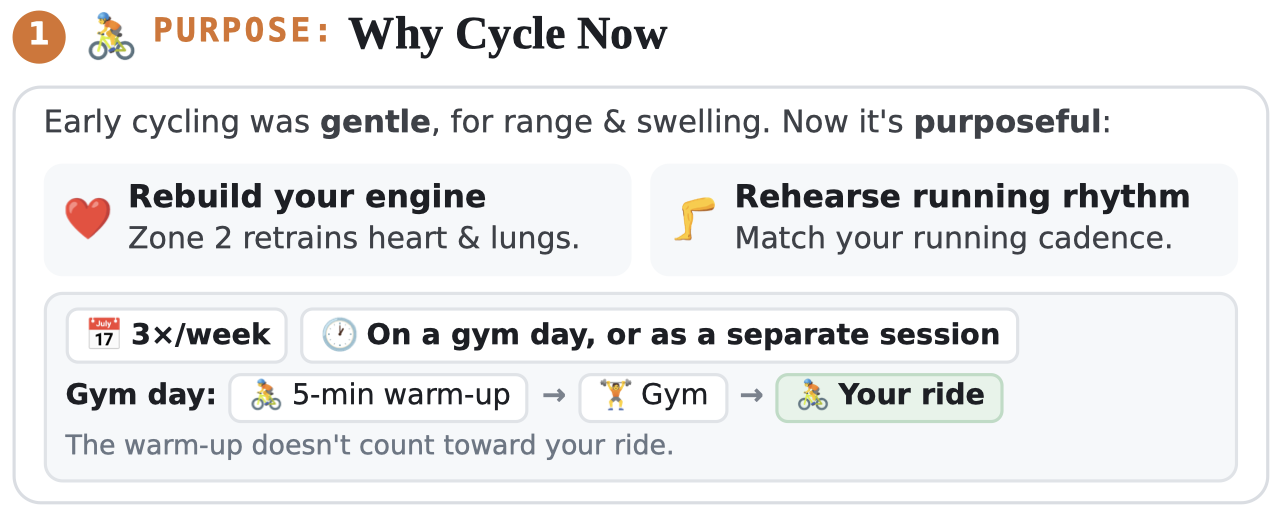
Why Cycle Now: Two Purposes
1. Rebuild your engine. By this point you haven't run for months, and your aerobic capacity has dropped. If I asked you to start running at 6 months without any preparation, you'd struggle. Your heart and lungs would be working overtime and you'd be panting heavily. The bike is the bridge that rebuilds your engine before you need it.
2. Rehearse your running rhythm. This is about cadence, which is so important that it gets its own section below. If you pedal at your running cadence, your legs learn the rhythm before they ever hit the ground.
How Often
- 3 times a week, or more.
- Do it on a gym day or as a separate session between gym days.
- On a gym day: 🚴 your usual 5-minute warm-up ride → 🏋️ gym → 🚴 your Cycle to Run ride.
- The warm-up doesn't count. Your official ride is the one I describe below.
Understanding Cadence
To understand this program, you need to understand cadence. If you're not a runner or a cyclist, the term may be new to you.
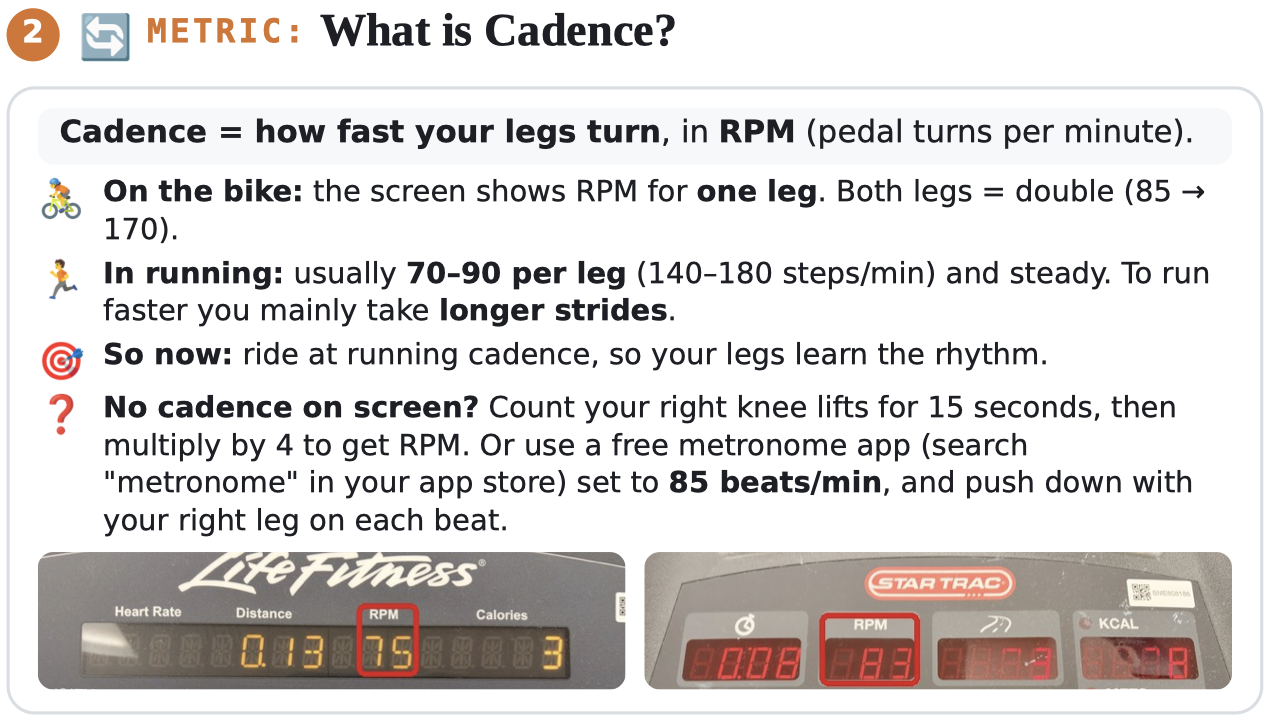
Cadence is how fast your legs turn. On the bike it's measured in RPM (pedal revolutions per minute). In running it's steps per minute. Either way, it's cadence.
- On the bike, the screen shows RPM for one leg. Some bikes show the doubled number for both legs, so 85 RPM appears as 170. It's the same cadence.
- In running, here's the interesting part. Most of us hold a steady cadence of 70–90 steps per leg. When you run faster, it's mainly your stride length that increases, not your cadence. Your cadence stays about the same.
So in Cycle to Run, you ride at your running cadence so your legs learn the rhythm.
A Triathlon Principle
This is a key principle in triathlon. You swim, you cycle, and then you run, so how do you best prepare your legs for the run? You cycle at your running cadence.
When I ride the 40km bike leg of an Olympic-distance triathlon, I keep my cadence between 70 and 90 RPM. That way the run off the bike feels smooth. I'm doing the same thing with you here.
The One Number to Watchs.
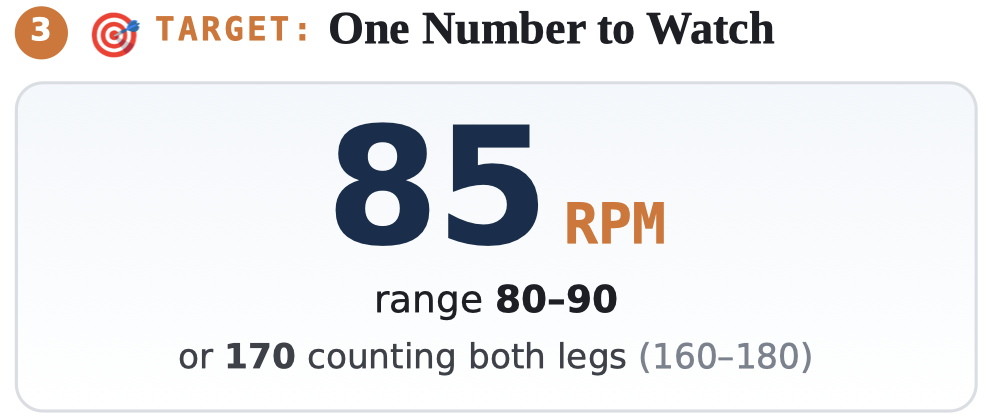
Watch this number for the whole ride.
Intensity: Heart Rate
Once you know your cadence target, you need your intensity target. I'm a big believer in heart rate monitoring.
Getting your heart rate:
- Most gym stationary bikes have two hand sensors on the handlebars that show your heart rate on the dashboard.
- Alternatively, a wrist-based optical heart rate monitor is quite inexpensive nowadays.
Your zone: Max HR ≈ 220 − age, and Zone 2 = 65–80% of max, minus 10 bpm.
Why minus 10? Because cycling is non-weight-bearing. The bike carries your body weight, so your heart rate runs lower than it would when running at the same effort. If I asked you to reach your running heart rate on the bike, you'd find it hard. I've already subtracted the 10 bpm from every number below, and these targets are safe to follow.
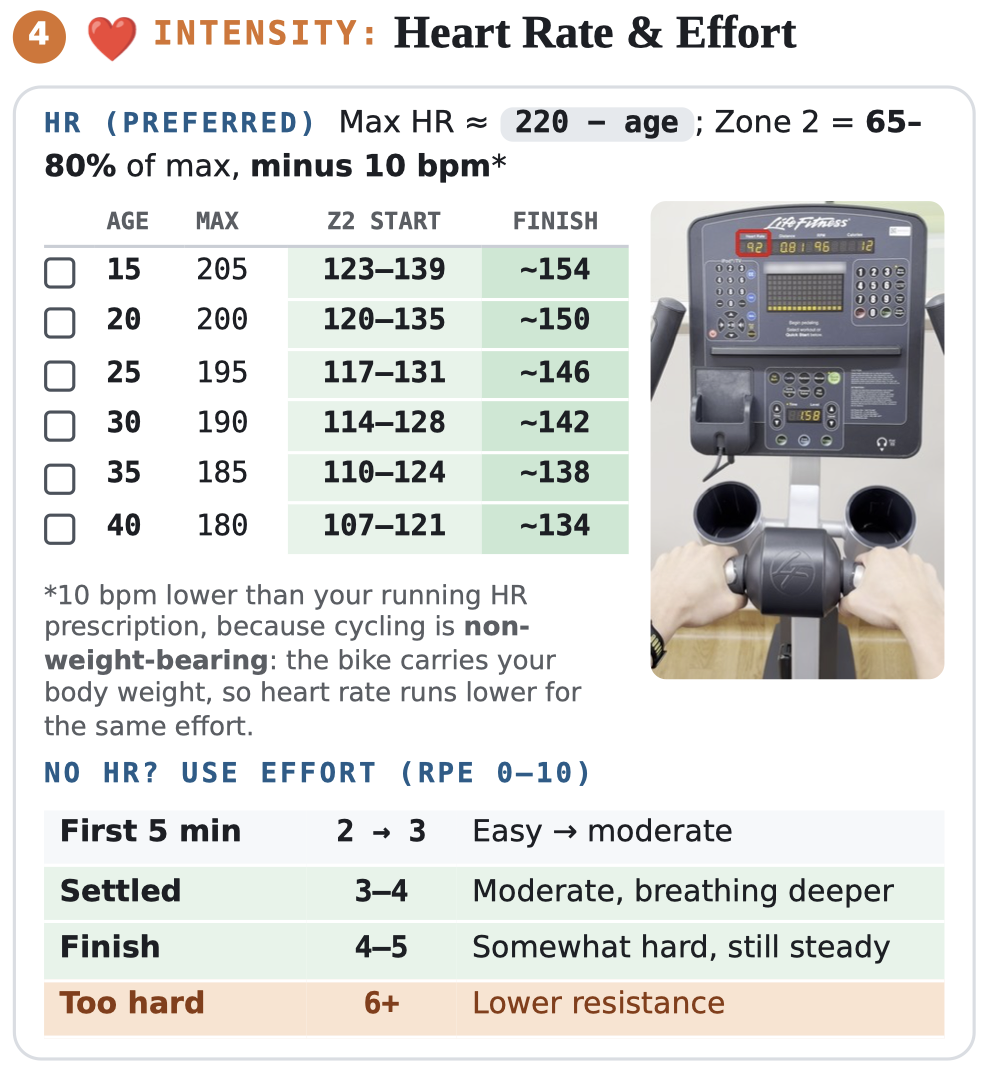
Zone 2 Start is the bottom half of your Zone 2, where you settle in. Zone 2 Finish is the top of Zone 2, where you end the ride.
No Heart Rate Monitor? Use Effort (RPE 0–10)
If you really can't get a heart rate reading, use your Rate of Perceived Exertion (RPE). 0 is a chill day and 10 is pushing really hard.
Point in the ride | RPE | How it feels |
First 5 minutes | 2 → 3 | Easy, building to moderate |
Settled | 3–4 | Moderate, breathing deeper |
Finish | 4–5 | Somewhat hard, but still steady |
Too hard | 6+ | Lower the resistance |
RPE is very subjective, so I don't recommend it. Use a bike with heart rate sensors or get a heart rate monitor if you can.
How a Ride Works: Lock, Lock, Adjust
There are three factors in every ride:
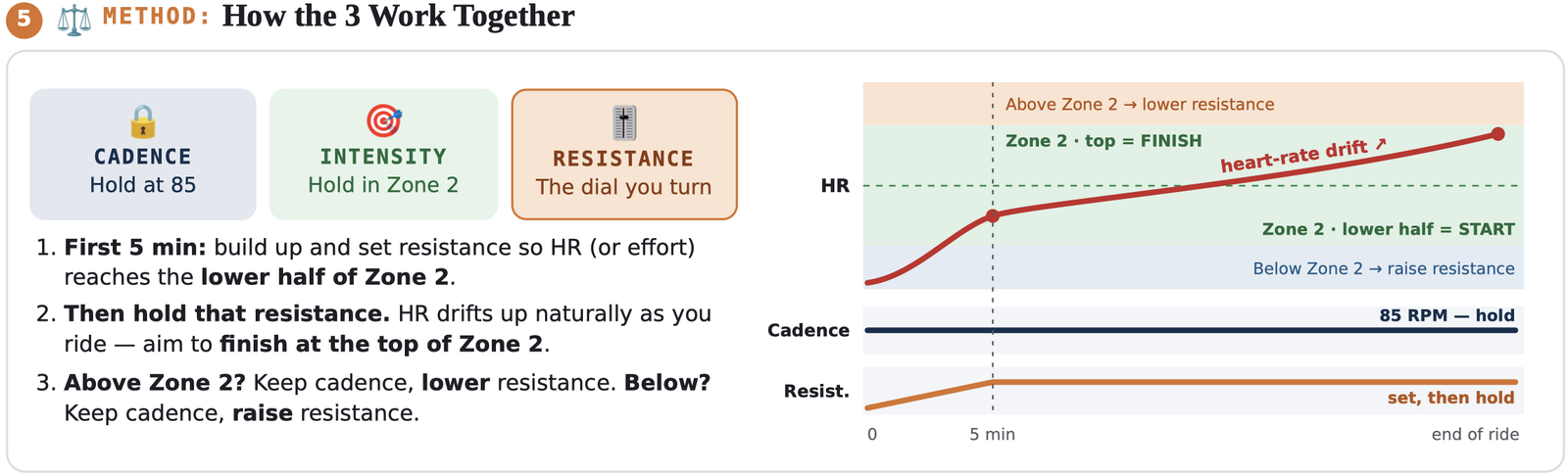
The first 5 minutes: Start pedalling straight away and bring your cadence up to 85. Your heart rate will start drifting upwards. While it does, slowly increase the resistance until you enter Zone 2 Start.
Then hold the resistance. Once it's set, leave it alone. Ride for your prescribed time and watch your heart rate rise slowly. You should end at the top of Zone 2.
If you misjudged the resistance and set it a little too high, your heart rate will cross into Zone 3 partway through the ride. When that happens, lower the resistance so your heart rate comes back down into Zone 2, then finish the ride there.
The general principle: cadence is always 85, and you adjust the resistance to keep your heart rate in Zone 2.
Your First Ride: Step by Step
- Find a stationary bike with heart rate sensors. Many gym bikes stay switched off until you start pedalling.
- Set your seat height. Stand beside the bike and find the bony point on the outside of your hip (the greater trochanter). Set the seat slightly lower than this point.
- Mount the bike and slip your feet into the pedal straps. Tighten them on both sides.
- Start pedalling and press Quick Start.
- Hold both hand sensors so the bike picks up your heart rate.
- Switch the display to show RPM, then bring your cadence to 85.
- Increase the resistance until your heart rate reaches Zone 2 Start.
- Hold that resistance and finish the ride.
When I demonstrate this myself, I'm close to 40, so my Zone 2 Start is 107. I start at 85 RPM with a heart rate of around 82, then raise the resistance step by step. My heart rate drifts up through 107 and settles at about 117, which is within my Zone 2. Then I leave the resistance alone and ride.
The 12-Week Progression
Every fourth week is a recovery week, when you deliberately do a bit less. That gives your body time to absorb the training before you load it again.
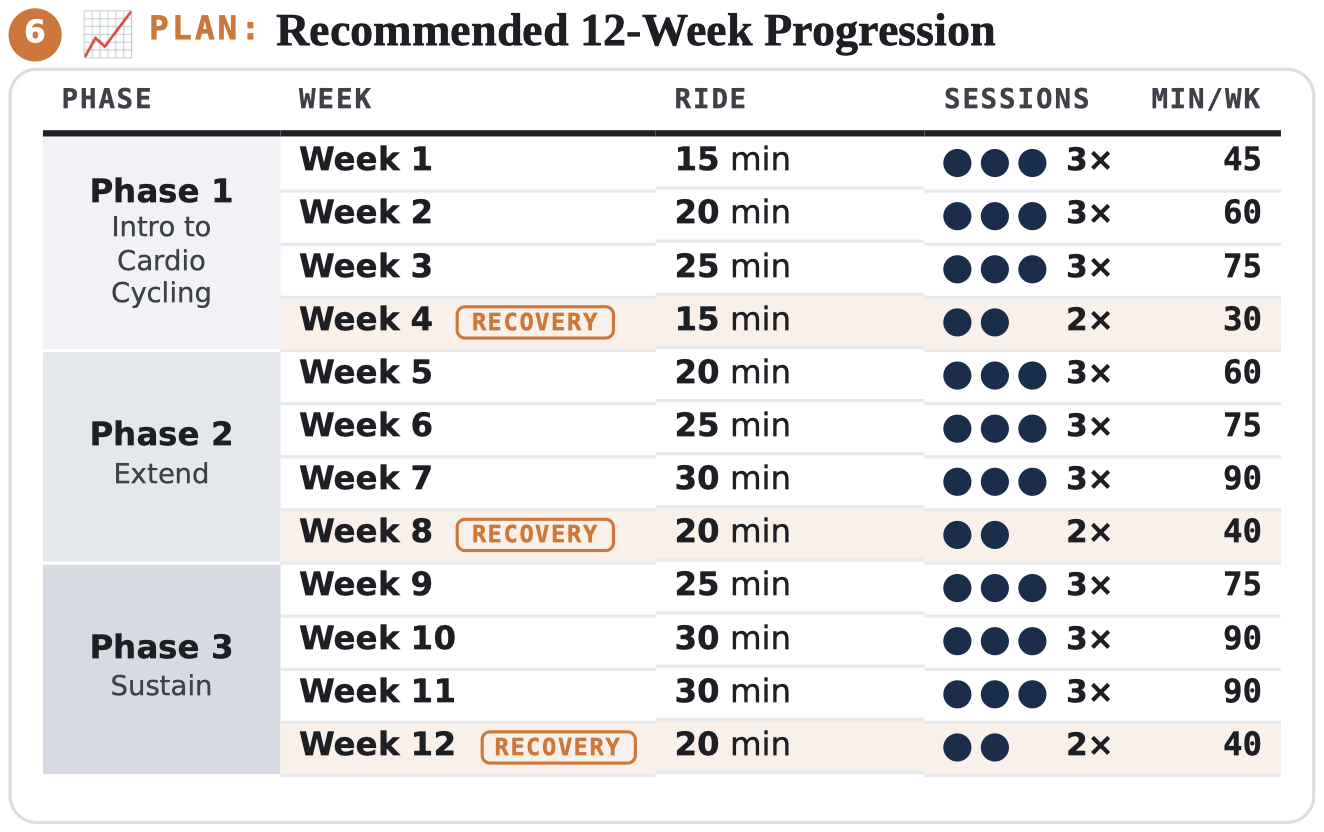
In Phase 1 you're introduced to cardio cycling. In Phase 2 you extend, pushing all the way to 30 minutes. In Phase 3 you hold and sustain at 30 minutes.
What My Patients Tell Me: Cadence Before Heart Rate
These are the two most common experiences my patients report, and they come from opposite ends of the spectrum.
"My legs felt like they were flying off the bike"
If you're not athletic or not a runner, cadence is the hardest part. You'll find it hard to reach 85.
One of my patients from a non-athletic background told me this about her first ride:
"First ride felt pretty intense. I think going from 60–70 RPM to 80 RPM was too big of a jump, so I couldn't really get used to it and was pedalling furiously. Almost felt like my legs were flying off the bike."
The solution: lower the resistance so you can hold 85. Your heart rate will drop a little when you do, and that's fine.
Here's what she told me after ride two, the very next morning:
"Cycled again this morning and I managed to maintain 85 RPM for most of the 15 minutes."
She improved that fast because cadence is mainly neuromuscular. Once your nerves are used to 85 RPM, it stops being a problem. In ride two she held a higher average heart rate and didn't need to drop the resistance until much later. That's exactly the heart rate chart I want to see. You'll find it easier within three sessions.
"My knee started feeling wobbly"
At the other extreme, if you're a very fit athlete, you may reach your heart rate zone easily, but your legs tire before the ride is done.
One of my patients, a club soccer player, said this after ride one:
"First 12 minutes felt nice and smooth. Last three minutes tried to push but my knee started feeling wobbly."
For him the limiting factor wasn't cadence or heart rate. It was strength. The fix is the same: drop the resistance to keep 85 RPM, and accept that your heart rate will dip.
After ride two:
"Felt really smooth and stable at 85. Monday it was still unstable but today it was much better."
He no longer needed to reduce the resistance. He could hold 85 RPM at a fixed resistance without feeling wobbly. Within five sessions, you'll be riding confidently in your prescribed heart rate zone.
The Principle
Cadence before heart rate. If you have to give something up, give up resistance. Never give up the 85.
After Week 12
Continue the 3 weeks on, 1 week recovery rhythm until you start Phase 5, when you begin running:
- On weeks: 30 minutes, 3 times a week.
- Recovery week: 20 minutes, 2 times a week.
30 minutes is good. If you really want more, you can push to 30–45 minutes, but keep a recovery week after every three weeks to absorb the training. And stick to 85 RPM.
If Knee Pain Occurs
Knee pain is very rare here. Cycling is very safe and knee-friendly. Aim for 2/10 pain or less while riding, and if pain goes above 3/10:
- A little tightness in the first 5 minutes only → it's okay, carry on as planned.
- Pain throughout the ride → go back a week, and progress only once things settle.
- Pain after the ride only → keep to the plan. If it's worse the next morning, go back a week in your progression.
- If in doubt → stay at your current ride time, whether that's 15, 20 or 25 minutes, and repeat it week on week until you see your physiotherapist.
What Comes Next
Phase 5: Return to Running Safely. You can start once you reach:
- Strength — Limb Symmetry Index (LSI) of 70% or more, on 1RM or isokinetic testing.
- Single-leg quality control — cleared on your physiotherapist's functional assessment.
By then your engine is rebuilt and your legs already know the rhythm. You'll be ready to run.
→ Read next: Return to Running Safely After ACL Reconstruction
Bottom Line
The bike isn't just a warm-up anymore. It's where you rebuild your engine and rehearse your rhythm.
Lock your cadence at 85, lock your heart rate in Zone 2, and adjust the resistance to keep both there. Put cadence before heart rate.
If you have any questions at all, drop me a message. I'm very happy to explain further. Enjoy your rehab, and I'll see you on the field soon.
Heart-rate zones per Strava, "Understanding Heart Rate Zones and How They Impact Your Training," minus 10 bpm for cycling. Entry criteria, cadence target, effort guide, and 12-week progression developed by Dr Mok Ying Ren with the NUH Sports Physiotherapists. Patient quotes shared with permission and anonymised.